
Purpose-built software for NDIS allied health providers
From client management and scheduling to NDIS claiming and compliance, Lumary AH connects your clinical team, operations and reporting on a single platform, built for the real-world demands of delivering allied health services under the NDIS.

Built for the allied health sector
Lumary has developed its platform alongside allied health providers delivering NDIS services across Australia. We understand:

Lumary has some genuinely amazing, talented, and intelligent people on their team and they make it a joy to work together. I can ask any question and I know someone there not only knows the answer, but they are ready and willing to jump in.

The pressures facing NDIS allied health providers are real.
Allied health providers working under the NDIS are navigating growing caseloads, complex documentation requirements, thin margins and increasing compliance expectations. When your clinical and administrative systems are disconnected, the cost compounds — delayed claims, missed service agreements, clinician burnout and poor participant visibility.
Lumary AH brings clarity and control so your team can focus on what matters most: delivering meaningful outcomes for participants.
Everything you need to deliver great allied health services under the NDIS
One platform.
Every allied health discipline.
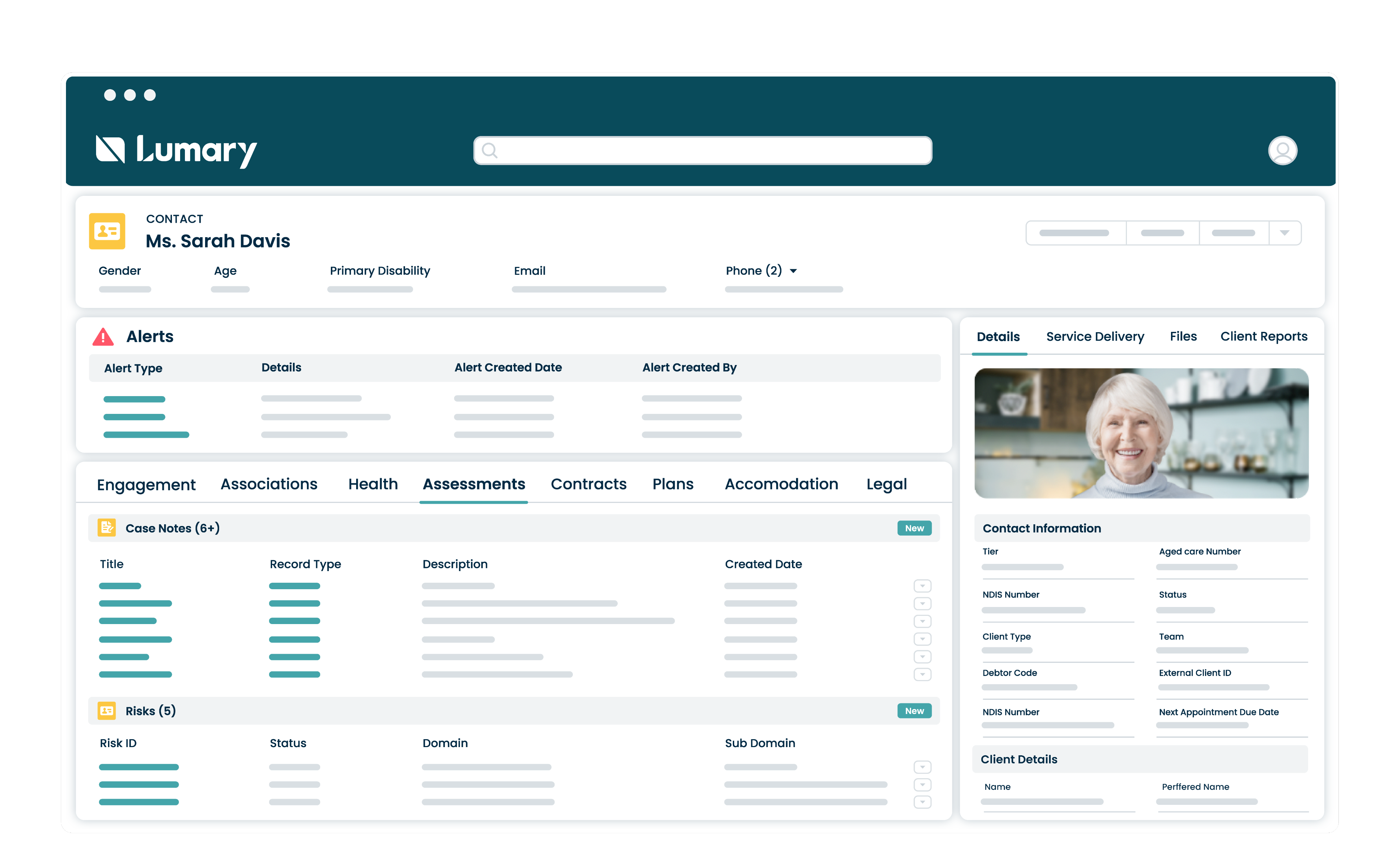
Lumary AH is a cloud-based practice management platform built on Salesforce, designed to connect every aspect of your NDIS allied health operation in a single, intelligent system.
Lumary AH
Designed for allied health organisations delivering OT, speech pathology, physiotherapy and behaviour support under the NDIS, Lumary AH brings clinical, workforce and financial management together in one place.
- Client & NDIS plan management
- Scheduling & clinical documentation
- NDIS claiming & invoicing
- Compliance, incident & quality reporting

Enterprise-grade security, built for NDIS compliance
Lumary AH is built on Salesforce, the world's #1 CRM, and backed by ISO 27001 certification and HIPAA compliance.
Our platform ensures your participant data, clinical records and financial information are protected with the highest standards of security and governance, so your organisation can meet its NDIS obligations with complete confidence.
Supporting providers delivering meaningful outcomes





Driving Efficiency & Growth for Sustainable Supports

Ignite Healthcare
Ready to transform your allied health practice?
Book a tailored demo to see how Lumary AH has helped allied health providers like yours improve compliance, streamline clinical workflows and deliver better outcomes for NDIS participants.
Frequently asked questions
What features should allied health providers look for in care management software?
Allied health practices have distinct requirements compared to disability or aged care providers — they need to manage clinical documentation across multiple disciplines, handle a mix of funding sources per client, and support both individual and group service delivery. The most important features to evaluate include:
Multi-discipline clinical documentation — flexible progress note templates that accommodate the different documentation standards of occupational therapy, physiotherapy, speech pathology, psychology, and other disciplines, with goal tracking and outcome measurement tools built in.
Appointment scheduling and diary management — intuitive, calendar-based scheduling for individual and group sessions, with automated reminders, waitlist management, and visibility across multiple practitioners and locations.
Multi-funder billing — the ability to manage invoicing and claiming across NDIS, Medicare (including MBS item numbers and bulk billing), private health insurance, DVA, and self-paying clients within a single client record.
Client and referral management — a centralised intake workflow that captures referral sources, waitlist status, consent, and funding details before the first appointment, reducing admin at the point of care.
Reporting and outcome measurement — standardised outcome tools (such as Goal Attainment Scaling, FIM, or AusTOMs) integrated into the clinical workflow, with aggregated reporting for funding body submissions and internal quality reviews.
Telehealth integration — built-in or seamlessly integrated video consultation capability, with session notes and billing triggered from the same platform as in-person appointments.
Team and supervision management — visibility over caseloads across the team, with tools to support clinical supervision, student placement management, and workload balancing.
The practical result is that allied health practitioners spend significantly less time on billing administration, invoice queries, and rejected claims — and practices recover more revenue from the services they've already delivered.
1
What is care management software for allied health providers?
Care management software for allied health providers is a purpose-built platform that helps multidisciplinary health businesses manage client records, appointments, treatment plans, progress notes, billing, and reporting in one connected system. It is designed for organisations delivering services such as physiotherapy, occupational therapy, speech pathology, psychology, dietetics, podiatry, and social work — particularly those working within funded programs like the NDIS, Medicare, or Home Care Packages.
Unlike generic practice management tools, allied health care management software is built to handle the complexity of working across multiple funding streams, managing diverse clinical workflows for different disciplines, and meeting the documentation and reporting requirements of schemes like the National Disability Insurance Scheme (NDIS) and the Medicare Benefits Schedule (MBS). For allied health businesses working with participants who have complex, long-term support needs, having the right software in place is foundational to delivering consistent, high-quality care while running a sustainable practice.
2
How does allied health software support NDIS service delivery and claiming?
Many allied health providers — including occupational therapists, physiotherapists, speech pathologists, and psychologists — deliver a significant portion of their services to NDIS participants. Managing NDIS-funded allied health services involves navigating support catalogue line items, service agreements, plan budgets, and the claiming process through the NDIS myplace portal. Purpose-built software supports this by:
- Mapping appointments directly to NDIS support catalogue line items, including Capacity Building and Core supports, so invoices are generated accurately from the moment a session is booked
- Tracking participant plan budgets in real time, giving therapists and coordinators visibility over remaining funding before scheduling new sessions
- Automating bulk claims submission to the NDIS portal via PRODA, reducing manual data entry and the risk of rejected or underclaimed invoices
- Supporting all participant management types — plan-managed, self-managed, and agency-managed — with appropriate invoice formats and workflows for each
- Generating clinical progress notes linked to NDIS goals and functional outcomes, creating the evidence trail needed for plan reviews and re-assessments
- Flagging service agreement expiry or budget exhaustion before it disrupts service delivery or creates a cash flow gap
For allied health businesses where NDIS participants represent a significant share of the client base, streamlined NDIS workflows can meaningfully reduce administration time and improve revenue recovery.
4
How does care management software handle billing across multiple funding sources?
Allied health providers frequently work with clients who are funded through a combination of sources — NDIS, Medicare, private health insurance, Department of Veterans' Affairs (DVA), aged care packages, or self-payment — and managing this complexity across separate systems creates significant administrative overhead and revenue risk.
Purpose-built care management software consolidates multi-funder billing into a single workflow by:
- Storing each client's active funding sources in their profile, so the correct billing pathway is automatically selected when an appointment is booked or a note is finalised
- Generating compliant invoices for each funder, including NDIS service bookings, Medicare bulk billing and patient claims, DVA invoices, and private health rebate receipts, without requiring manual reformatting
- Submitting Medicare claims electronically via HPOS integration, with real-time processing and remittance matching back to individual sessions
- Tracking client-level revenue across all funding streams in one view, so practice managers can identify underclaiming, funding gaps, or clients whose plans are approaching exhaustion
- Supporting plan management providers with correctly formatted tax invoices that meet NDIS plan manager requirements
The practical result is that allied health practitioners spend significantly less time on billing administration, invoice queries, and rejected claims — and practices recover more revenue from the services they've already delivered.
6
How much does allied health care management software cost, and how do I choose the right platform?
Allied health software is typically priced on a per-practitioner or per-user basis, with monthly subscription fees that generally range from around $50 to $200+ per practitioner depending on the platform, included features, and organisation size. Some vendors also charge additional fees for specific modules such as telehealth, outcome measurement tools, or NDIS claiming integrations.
When evaluating cost and fit, the most important considerations are:
Funding stream coverage — if your practice works across NDIS, Medicare, and private health, confirm the platform handles all three natively, not just as workarounds. Gaps here create hidden administration costs.
Discipline-specific workflows — a platform built for a single discipline (or for general medical practice) will require adaptation that adds friction and risk. Look for software with configurable templates and workflows that reflect how your clinicians actually document.
Implementation and onboarding support — the true cost of software includes the time to migrate data, train staff, and embed new workflows. A lower licence fee with poor onboarding support often costs more overall.
Ongoing regulatory alignment — the NDIS price guide, MBS item numbers, and aged care funding rules change regularly. Choose a vendor that updates the platform proactively in response to policy changes, so your team isn't left managing workarounds.
Scalability — if you plan to grow your team, add new service types, or open additional locations, confirm the platform supports this without requiring a system change at scale.
For most allied health businesses, the right care management software pays for itself through time savings on administration, faster claiming cycles, and reduced revenue leakage — typically within the first six to twelve months of implementation.