
Purpose-built software for disability providers
From Supported Independent Living to community-based services, Lumary connects your team, clients and workflows on a single platform, designed for the real-world complexity of the NDIS.

Deep roots in the
disability sector
Lumary has spent years building alongside disability providers navigating the complexity of the NDIS. We understand:


I realised we were struggling with data and efficiency, and so I wanted something that would streamline our processes and give us access to valuable insights. Lumary turned out to be the perfect fit —it’s truly been a game changer for us.
Ignite Healthcare

The pressures facing disability providers are real.
Disability providers are navigating rising costs, workforce shortages, margin compression and increasing regulatory scrutiny. When your systems don't talk to each other, the consequences compound, service inefficiencies, compliance gaps, staff burnout and cash flow pressure.
Lumary brings clarity and control to these challenges, so you can focus on what matters most: your clients.
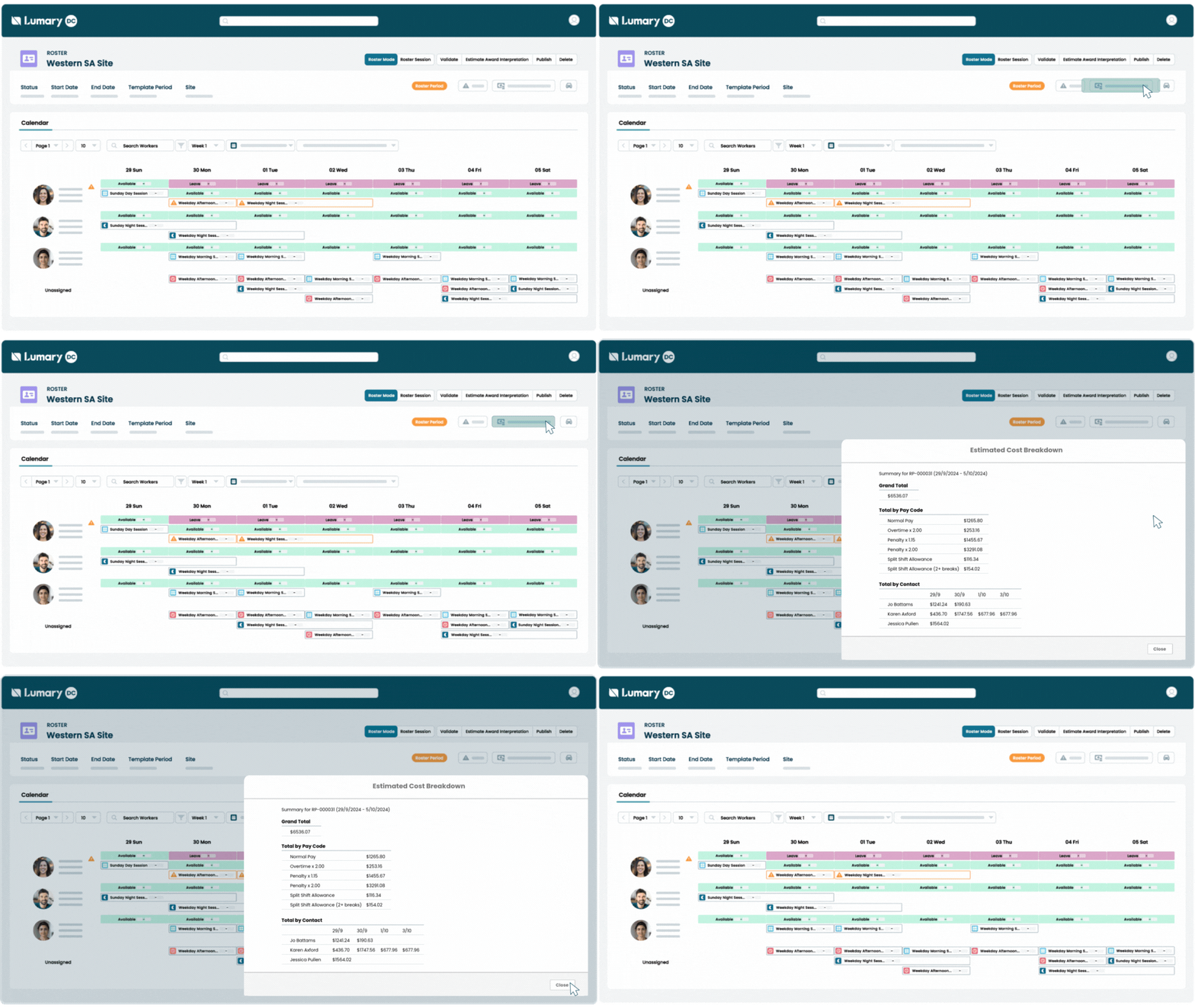
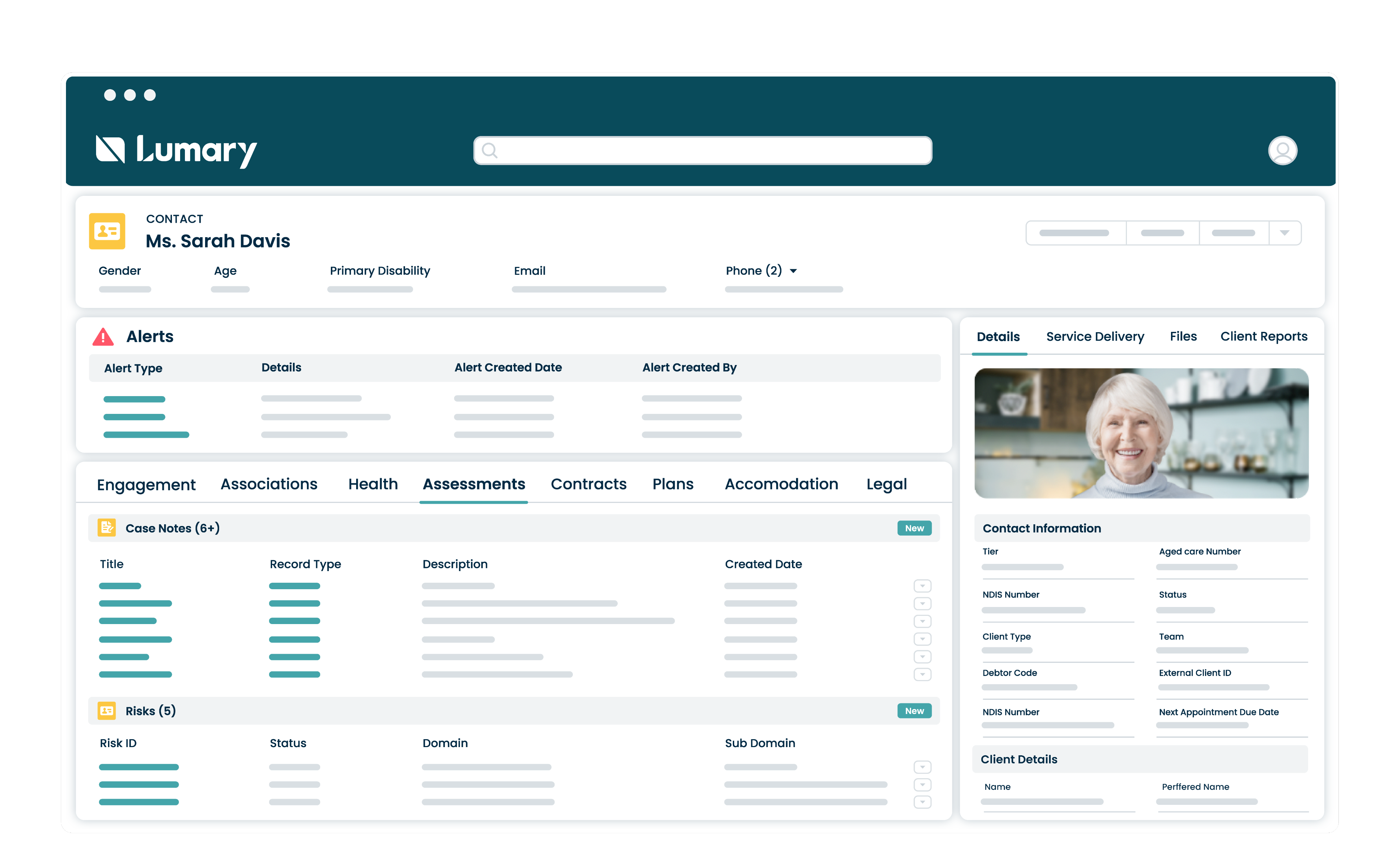
Everything you need to run a complete disability organisation
.png)
Two options.
Built to scale with you.
Lumary DC is designed for mid-to-large disability providers. Choose the option that fits where you are today and grows with you.
DC Pro
Designed for small to mid-sized providers who need a clear platform to manage clients, roster staff and stay compliant.
- Full client & plan management
- Rostering with rule-based configuration
- Contract and roster visibility
- Compliance reporting from pricing
DC Enterprise
For larger, more complex providers with advanced governance, multi-site operations and reporting requirements.
- Enterprise audit & implementation support
- Configurable architecture for complex environments
- Automated reporting & governance workflows
- Real-time financial controls & oversight

Built for compliance. Designed for confidence.
Lumary provides enterprise-grade security aligned to disability sector regulations.
Our platform supports data protection, audit trails, governance controls and reporting transparency — helping you meet your obligations with confidence.
Supporting providers delivering meaningful outcomes






Driving Efficiency & Growth for Sustainable Supports

Ignite Healthcare
Ready to transform your disability operations?
Book a tailored demo to see how Lumary has helped providers like yours improve compliance, streamline workforce management and strengthen financial accountability across their organisation.
Frequently asked questions
1
What is care management software for disability providers?
Care management software for disability providers is a purpose-built digital platform that helps organisations plan, deliver, and track support services for people with disability. It centralises client records, support plans, scheduling, shift management, progress notes, and financial claiming into a single system, replacing disconnected spreadsheets, paper-based processes, and generic tools that aren't built for the sector.
For providers operating under the National Disability Insurance Scheme (NDIS), care management software is typically designed to align with NDIS requirements, including support catalogue structures, service agreements, and PRODA/myplace portal integration. This means teams spend less time on administration and more time delivering quality, person-centred support.
2
How does care management software help NDIS providers stay compliant?
NDIS compliance requires providers to meet obligations set by the NDIS Quality and Safeguards Commission, including accurate record-keeping, incident reporting, progress notes, and adherence to the NDIS Practice Standards. Purpose-built care management software supports compliance by:
- Capturing structured progress notes at the point of care, tied directly to support goals
- Automating incident reporting workflows to meet mandatory timeframes
- Maintaining a complete, auditable history of service delivery against each participant's plan
- Generating reports that map directly to NDIS Practice Standards evidence requirements
- Flagging budget overruns or plan expiry dates before they become compliance risks
When compliance is built into the workflow rather than bolted on as an afterthought, teams are far less likely to fall through the gaps, and audits become straightforward rather than stressful.
3
What features should I look for in NDIS care management software?
The right care management software for an NDIS provider should cover the full service delivery lifecycle. The most important features to evaluate include:
Scheduling and rostering: drag-and-drop shift management, real-time visibility across your workforce, and automated alerts for unfilled shifts or compliance gaps like expired worker checks.
Client and plan management: a centralised participant profile with support plans, goals, service agreements, and funding budgets in one place.
Progress notes and incident reporting: mobile-friendly note-taking at the point of care, with structured templates aligned to NDIS requirements.
NDIS billing and claiming: automated bulk claims submission to the NDIS portal (PRODA), support for all line items across the NDIS support catalogue, and real-time budget tracking against participant plans.
Reporting and analytics: dashboards that give leadership visibility over service delivery, staff utilisation, revenue, and compliance performance.
Integrations: connections to payroll, accounting (e.g., Xero, MYOB), HR, and rostering platforms to avoid double-handling data.
A platform that handles all of these in a single, connected system will reduce administration, minimise errors, and give your team a complete picture of every participant.
4
How does care management software integrate with the NDIS portal and claiming process?
NDIS billing is one of the most time-consuming and error-prone parts of running a disability support business. Good care management software integrates directly with the NDIS myplace portal via PRODA to automate the bulk claiming process. Rather than manually entering service bookings and payment requests line by line, the software generates claim files from completed and verified shifts, checks them against the NDIS price guide, and submits them in bulk.
Key integration capabilities to look for include:
- Automated bulk claim generation from delivered and approved shifts
- Real-time plan balance tracking so staff know how much funding remains before booking new supports
- Error checking before submission to catch line item mismatches, price guide exceedances, or missing service bookings
- Remittance reconciliation to match NDIS payments back to individual claims automatically
- Support for all funding types, including plan-managed, self-managed, and agency-managed participants
Strong NDIS integration significantly reduces the time between service delivery and payment, improving cash flow and reducing the risk of rejected claims.
5
How much does care management software for disability providers cost, and is it worth the investment?
Pricing for care management software varies depending on the size of your organisation, the modules you need, and the vendor's pricing model. Most platforms charge either a per-participant fee (typically ranging from a few dollars to $30+ per active participant per month), a per-user seat licence, or a combination of both. Enterprise arrangements for larger providers are often negotiated as a fixed annual contract.
When evaluating cost, it's more useful to calculate the return on investment than to focus on the licence fee in isolation. Consider:
- Administration time saved: providers that move from manual processes to integrated software typically reduce billing and scheduling admin by 30–50%
- Claim accuracy improvements: fewer rejected or underclaimed invoices mean more revenue recovered per participant
- Compliance cost reduction: avoiding a single Commission audit finding or incident breach can outweigh years of software costs
- Staff retention: reducing administrative burden on support workers and coordinators improves job satisfaction and lowers turnover
- Scalability: the right platform grows with you, so you're not rebuilding systems every time you take on new clients or expand into new service types
For most NDIS providers, purpose-built care management software pays for itself within the first year, and the cost of not having the right system grows significantly as your organisation scales.